
How EMI Is Calculated: Formula, Worked Example and What Changes It
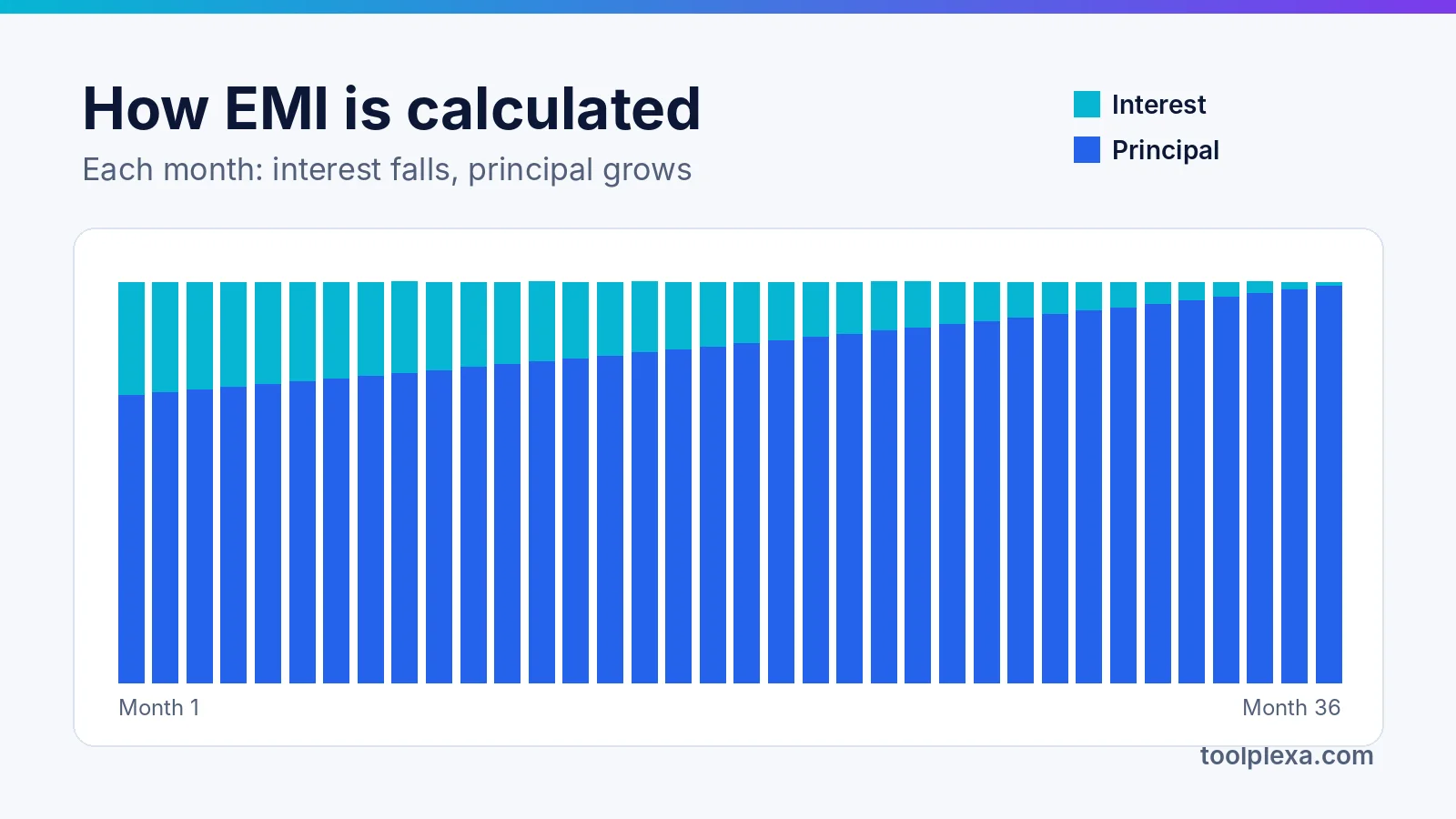
An EMI (equated monthly instalment) is the fixed amount you pay your lender every month until a loan is fully repaid. Each EMI does two jobs at once: it pays the interest due for that month, and whatever is left over reduces the amount you still owe. Because the amount you owe keeps falling, the interest part shrinks every month and the principal part grows, even though the EMI itself stays the same.
This guide shows the formula banks use, works through a real example line by line, and explains what actually happens to your EMI when the interest rate changes.
The EMI formula
Almost every bank and NBFC in India uses the reducing-balance formula:
EMI = P × r × (1 + r)^n ÷ ((1 + r)^n − 1)
- P – the loan amount (principal).
- r – the monthly interest rate: the yearly rate ÷ 12 ÷ 100. So 11% a year becomes 0.11 ÷ 12 = 0.009167.
- n – the number of monthly instalments: 3 years = 36, 20 years = 240.
The most common mistake when doing this by hand is using the yearly rate instead of the monthly one. If your answer looks far too large, check r first.
Worked example: ₹5 lakh for 3 years at 11%
Take a personal loan of ₹5,00,000 at 11% a year for 36 months.
- Monthly rate: r = 11 ÷ 12 ÷ 100 = 0.0091667
- (1 + r)^36 = 1.3888 (rounded)
- EMI = 5,00,000 × 0.0091667 × 1.3888 ÷ (1.3888 − 1) = ₹16,369
Over 36 months you pay 36 × ₹16,369 = about ₹5,89,297. Of that, ₹89,297 is interest.
Why the first EMIs are mostly interest
In month one you owe the full ₹5,00,000, so the interest for that month is 5,00,000 × 0.0091667 = ₹4,583. The rest of the EMI, ₹11,786, reduces the loan. In month two the interest is worked out on the smaller balance, so it is a little lower, and a little more of the EMI goes to principal. By the end of the first year the balance is about ₹3,51,215.
| Month | EMI | Interest | Principal |
|---|---|---|---|
| 1 | ₹16,369 | ₹4,583 | ₹11,786 |
| 12 | ₹16,369 | ₹3,339 | ₹13,030 |
| 36 | ₹16,369 | ₹149 | ₹16,221 |
This is why paying something extra early in a loan saves far more interest than the same prepayment near the end. You can see the full month-by-month table for your own numbers in the EMI Calculator.
Shorter or longer tenure?
Stretching the same ₹5 lakh loan from 3 years to 5 years cuts the EMI from ₹16,369 to about ₹10,871. That feels easier each month, but the total interest rises from ₹89,297 to about ₹1,52,273. A longer tenure lowers the EMI; it does not make the loan cheaper.
A useful rule: choose the shortest tenure whose EMI still leaves you a comfortable monthly buffer. Many lenders look for total EMIs to stay within roughly 40–50% of take-home pay, but your own budget matters more than the lender's limit.
What happens when a floating rate changes
Most home loans and many personal loans in India are on a floating rate. When the benchmark rate rises, the lender usually does one of two things: raises your EMI, or keeps the EMI the same and adds months to the loan.
Here is how big the difference can be. Take a ₹30 lakh home loan at 8.5% for 20 years (EMI about ₹26,035). After 5 years, the rate goes up by 1% to 9.5%:
| Option | New EMI | Extra cost over the loan |
|---|---|---|
| Raise the EMI, keep the end date | about ₹27,607 | about ₹2.8 lakh |
| Keep the EMI, extend the tenure (~27 more months) | ₹26,035 | about ₹6.9 lakh |
Keeping the EMI unchanged feels painless, but in this example it costs well over twice as much. If your budget allows, a higher EMI is almost always the cheaper choice.
Your rights as a borrower: the Reserve Bank of India's circular of 18 August 2023 on EMI-based floating-rate personal loans asks lenders to explain how a rate reset affects your EMI and tenure, and at reset time to give you a choice – including raising the EMI, extending the tenure, a mix of both, or prepaying – plus the option to switch to a fixed rate under the lender's policy. Check your loan's key fact statement and ask your lender which options apply to you.
Flat rate vs reducing balance
Some dealers and small lenders quote a flat rate, where interest is charged on the full original amount for the whole term. A 10% flat rate costs much more than a 10% reducing-balance rate, because you keep paying interest on money you have already returned. If a quote looks unusually low, ask which method is used, then compare the monthly EMI and total payable – not the headline rate.
Quick checklist before you sign
- Confirm the rate is on a reducing balance, and whether it is fixed or floating.
- Compare loans by total amount payable, including processing fees.
- Ask what happens to your EMI and tenure when the rate resets.
- Check prepayment and foreclosure charges before you plan any part-payments.
- Run your own numbers in the EMI Calculator, and use the Compound Interest Calculator to compare prepaying against investing the same money.
The figures in this article are rounded and for illustration only. Your lender's statement is the final word on what you owe.
Source: Reserve Bank of India – Reset of Floating Interest Rate on EMI based Personal Loans (18 Aug 2023)